

Image: AI-generated with Google Flow
The Wearable Metamaterial That Could Make MRI Faster, Cheaper and Sharper
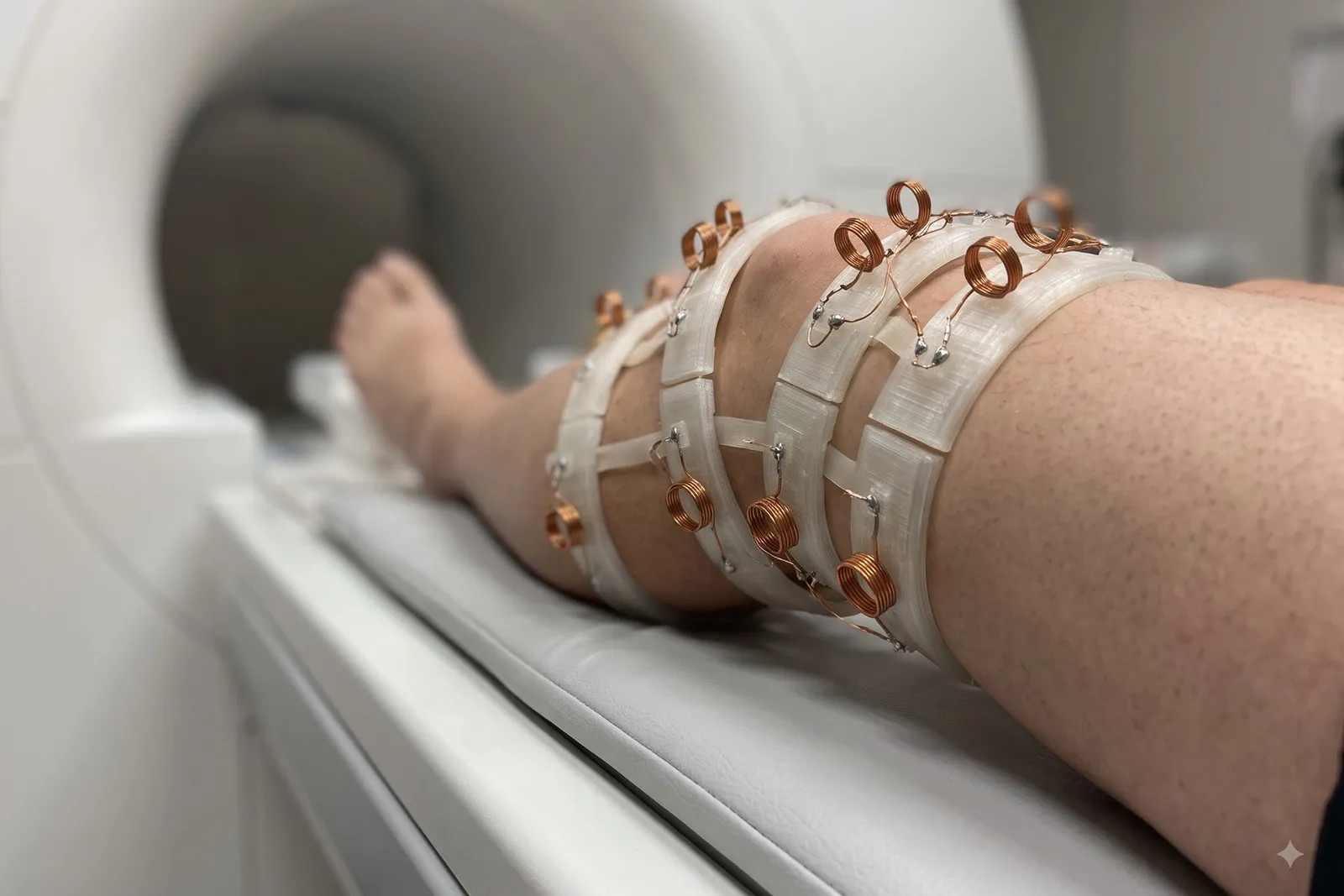
Engineers at Boston University (BU) have built wearable "metamaterials", sleeves and cuffs of small copper coils on 3D-printed plastic, or loops of ordinary coaxial cable, that sit on the body during an MRI scan and strengthen the signal the scanner picks up. A stronger signal can mean sharper images, shorter scans, or both: the team's earlier helmet version was reported to capture brain images at double the usual speed. and one of its newer designs uses only about $50 of supplies. The devices are still at the research stage, not in hospitals, but they point to a cheap way of getting more out of MRI machines, including the lower-cost scanners that could widen access in countries like India.
How we put this together: from Boston University's own reports on the work, an earlier HospiMedica report on the helmet, and the three 2024 journal papers they link to (Advanced Science, Advanced Materials and Science Advances), all listed under Sources and checked on 3 November 2026. We have not seen or tested the devices. Where the published reports give no figure, for example on signal gain for the 2024 designs, we say so rather than estimate one. This article explains research; it is not medical advice.
Why MRI is slow and expensive in the first place
An MRI scanner uses a powerful magnet and pulses of radio waves to make the body's hydrogen nuclei give off a faint radio signal, which coils near the body pick up and a computer turns into images (NIBIB, US National Institutes of Health). That signal is weak. To get a clear picture, scanners either use very strong, very expensive magnets, or they collect the signal for longer, which means long scans in which patients must lie still.
Image quality comes down to the signal-to-noise ratio (SNR): how much useful signal there is compared with background noise. Raise the SNR and a scanner can produce a sharper image in the same time, or the same image in less time. That is the lever the BU team is pulling. Shorter scans would also be kinder to anyone who finds lying still inside the tunnel stressful; the simple breathing practices in our beginner's guide to mindfulness meditation are one way some people cope.
What a metamaterial is, and what this one does
A metamaterial is an engineered structure whose behaviour comes from its shape and arrangement rather than from what it is made of. The BU group, led by Xin Zhang, a Distinguished Professor of Engineering, builds arrays of tiny resonators: coils tuned to "ring" at the same radio frequency the MRI scanner uses. Placed around the body part being scanned, the array gathers and focuses the magnetic field of that radio signal, boosting the SNR (BU, August 2024).
The resonators are simply tuned shapes of copper and plastic, or of coaxial cable, so they are cheap to make. In effect, they are a lens for the scanner's radio signal that the patient wears. Copper itself has become a strategic metal for many governments, as our critical minerals explainer describes, but the amounts in a cuff are tiny.
Four devices, one idea
| Device | Made of | Body part | What has been reported |
|---|---|---|---|
| Helmet (2022) | Copper wire coiled around 3D-printed plastic tubes, set in an array | Head | Sharper brain images at double the usual speed |
| Computer-designed cuffs (Advanced Science, 2024) | Helical resonators of plastic and thin copper coils | Knee, ankle, elbow, any body part | Layout calculated from a 3D body scan in under a second; improves SNR |
| Fabric knee pad (Advanced Materials, 2024) | Coaxial-cable loops on lightweight fabric | Knee | About $50 of supplies; reduces the electric field reaching the patient |
| Wireless cable cuffs (Science Advances, 2024) | Freestanding coaxial-cable rings, no fabric | Spine, wrist, a single finger | Passively amplified the signal and gave crisp images in every experiment |
The helmet: twice as fast
The team's first wearable, reported in February 2022, was a dome that fits over the head during a brain scan. Its array is made of copper wire coiled around 3D-printed plastic tubes. HospiMedica reported that it boosts MRI performance and produces sharper pictures in half the usual time, and that the team hoped it could help lower-cost, low-field scanners, above all in developing countries.
Cuffs designed by computer for any body part
A helmet suits a head, but knees and elbows are awkward shapes. In a paper in Advanced Science, first author Ke Wu, a postdoc working with Zhang, describes software that takes a 3D scan of a body part and, in less than a second, works out where to place each helical resonator, using a geometric method called circle packing. The resonators, thin copper coils built on plastic, are set into wearable cuffs that follow the shape of a knee, an ankle or the head while staying tuned to the right frequency. This work was funded in part by the US National Institute of Biomedical Imaging and Bioengineering (BU).
A fabric pad for about $50
The second 2024 paper, in Advanced Materials with graduate student Xia Zhu as first author, swaps the copper-and-plastic coils for loops of coaxial cable on a light fabric pad. BU says each one uses only about $50 of supplies. The design also sharply reduces the electric field near the device, which limits the patient's exposure to it.
Wireless rings that need nothing else
The third paper, in Science Advances, co-authored with Stephan W. Anderson, a professor of radiology at BU's Chobanian & Avedisian School of Medicine, drops the fabric altogether. The coaxial cables are formed into freestanding rings and cuffs, sized for a single finger, the wrist and the spine. According to BU, they passively tuned and amplified the MRI signal and produced crisp images in every experiment the team ran.
The scanner doesn't change. A few dollars of copper and cable around the knee changes how much of its signal is caught.
Faster, cheaper, sharper: how much of that is proven?
- Faster: the one published speed figure is for the 2022 helmet, which halved the usual scan time. BU's 2024 reports give no scan-time figures for the newer cuffs and pads.
- Cheaper: the clearest cost figure is about $50 of supplies for the fabric pad. That is the device, not a scan; the bigger saving would come from making cheaper low-field scanners good enough to use.
- Sharper: all three 2024 papers report a better signal-to-noise ratio, but the BU summaries don't put a percentage on it.
- Stage: the reports describe prototypes and demonstrations. None mentions clinical trials or regulatory approval, which any medical device needs before hospitals can use it.
Why it matters for India
The team frames the work around low-resource and remote areas, and Zhang has said she hopes the designs will let more patients around the world benefit from MRI (BU). The same logic applies to India. Low-field MRI machines are the cheaper option, but a weaker magnet means a weaker signal and noisier images. A wearable that lifts their signal could make them good enough for more everyday scans, such as a knee or a wrist, without the cost of a high-field system.
That is a possibility, not a promise. Before any such device reaches an Indian hospital it would need clinical testing on patients, manufacturing at scale, and approval as a medical device. If you are waiting for a scan, nothing here changes what your doctor will order today. And if it is a knee or back that sent you to the scanner, our guide to starting strength training safely covers the evidence on keeping joints and muscles working as you age.
The idea in one paragraph
Boston University's wearable metamaterials are arrays of tuned copper-and-plastic coils or coaxial-cable loops that a patient wears during an MRI scan. They focus the scanner's radio signal and improve the signal-to-noise ratio, which can mean sharper images or shorter scans; the 2022 helmet was reported at twice the normal speed, and a 2024 fabric version costs about $50 in supplies. The devices are still research prototypes. If they pass clinical testing, their biggest impact may be making cheaper, low-field MRI good enough for places where today's scanners are out of reach.
Frequently asked questions
What is a wearable metamaterial for MRI?
It is a sleeve, cuff, pad or helmet made of small resonators, coils of copper on plastic or loops of coaxial cable, tuned to the MRI scanner's radio frequency. Worn over the part being scanned, it concentrates the signal and improves image quality; the newest design does this entirely wirelessly.
Is the BU wearable MRI device available in hospitals?
No. The published work describes research prototypes. Clinical trials and medical-device approval would come before any hospital use, and the reports don't mention either yet.
How much does the device cost?
BU says its fabric-based version uses only about $50 of supplies. That is the cost of materials for a prototype, not a retail price.
Does it make MRI scans faster?
The 2022 helmet was reported to capture brain images at double the usual speed. A stronger signal can be traded for shorter scans, but the 2024 reports don't give scan-time figures for the newer designs.
Sources
- Metamaterials for more accessible MRI, Kat J. McAlpine, Boston University, 9 August 2024.
- Wearable metamaterial helmet for MRI, HospiMedica, 14 February 2022.
- Computer-designed wearable resonator cuffs, Ke Wu and colleagues, Advanced Science, 2024.
- Fabric metamaterial of coaxial-cable loops, Xia Zhu and colleagues, Advanced Materials, 2024.
- Wireless form-fitting MRI metamaterial, Science Advances, 2024.
- How MRI works, National Institute of Biomedical Imaging and Bioengineering, accessed 3 November 2026.