
7 Minimalist Living Room Ideas That Maximize Small Spaces
A small living room rarely suffers from a lack of space so much as a surplus of things competing for it. These minimalist living room ideas for small spaces focus on what genuinely changes how a room feels: visible floor, quiet colour, considered light and furniture that leaves room to breathe.
Minimalism is often mistaken for an aesthetic of white walls and empty shelves. In a small room it is better understood as a discipline of priorities: deciding what the room is for, keeping only what serves that purpose, and giving each remaining object enough space to be appreciated.
That discipline matters more in a compact living room than anywhere else in the home. It is where you relax, host, work and sometimes eat, often within a few square metres. Every piece of furniture has to justify its footprint.
The seven ideas below draw on established interior design principles rather than passing trends. Each explains the principle, how to apply it, and the mistake that most often undermines it.
Why minimalism suits small living rooms
The eye reads space through cues: how much floor it can see, how far it can look before something interrupts it, and how many distinct objects it has to process. Clutter shortens all three. A minimalist approach lengthens them, which is why a carefully edited small room can feel more generous than a larger, crowded one.
Minimalism is also practical: fewer objects mean less to clean and more flexibility when the room needs to change role.
Seven minimalist living room ideas for small spaces
1. Edit before you buy
The most effective space-saving tool costs nothing. Before buying storage or a smaller sofa, take out everything that does not belong in the room or does not earn its place, then reintroduce items one at a time.
Work by category, such as books, cables, throws and decorative objects, and ask whether each item is used, loved or necessary. Relocate the rest, donate it or sell it. Only once the room has been edited will you know what storage you genuinely need.
Common mistake: buying organisers first. Storage bought to contain clutter tends to invite more of it.
2. Choose leggy furniture and show the floor
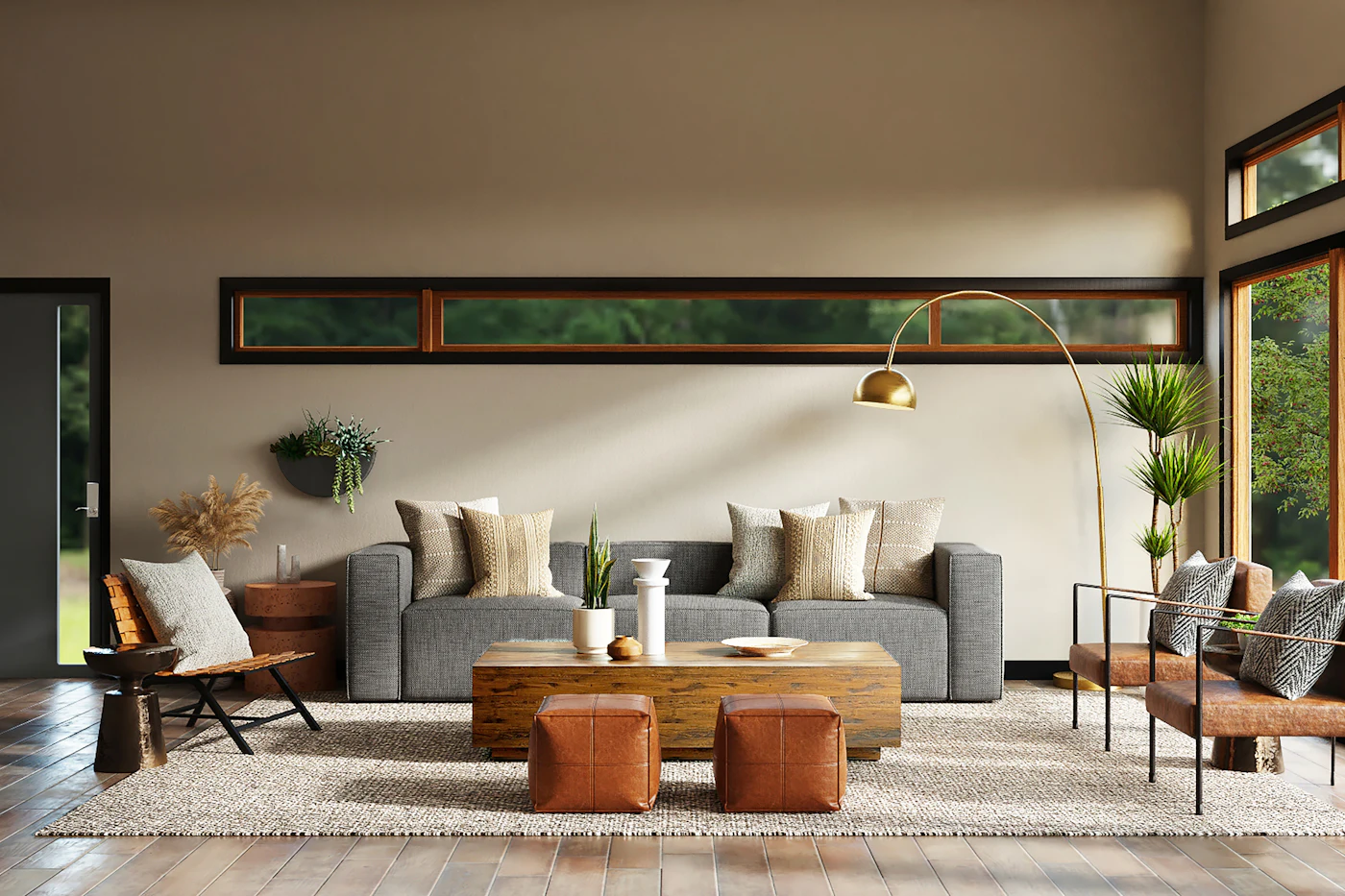
Furniture raised on slim legs lets light and sightlines pass underneath, so the floor appears to continue beneath it. Because the eye judges a room partly by the floor area it can see, raised pieces feel lighter than those that sit flat on the ground.
Look for sofas, sideboards and armchairs on tapered timber or metal legs, and consider a coffee table with a slim profile or a glass top. Keep the space beneath furniture clear; a gap stuffed with baskets loses its effect.
Common mistake: mixing too many leg styles and finishes. Two or three consistent materials look calm; six look busy.
3. Float your storage
Wall-mounted storage frees floor area and draws the eye upward. Floating shelves, a wall-hung media unit or a slim cabinet mounted off the floor give you the capacity of freestanding furniture without the visual weight.
Use closed storage for everyday clutter and keep open shelving for a few objects on display. Furniture that works twice helps too: storage ottomans, a lift-top coffee table or nesting side tables.
Common mistake: filling every shelf. Open shelving only reads as minimal when a good portion of it is left empty.
4. Commit to a tonal palette
A tonal palette uses several shades of one colour family, from warm white through oatmeal to sand, or soft grey through to charcoal. With fewer contrasts to process, edges blur and the room feels more continuous.
Choose a base colour for walls and large furniture, then add depth through texture: linen, bouclé, wool, timber and stone. Painting skirting boards, and even the ceiling, in a close shade of the walls removes hard lines that otherwise box a room in.
Common mistake: going stark white everywhere. In a small room with limited daylight, pure white can look grey and flat, and slightly warmer or softer tones are often more forgiving. Test samples on the wall at different times of day.
5. Layer your lighting
A single ceiling light flattens a room and exposes its boundaries. Layered lighting, combining ambient, task and accent sources, creates pools of light and shadow that give a small space depth.
Pair a soft overall source with a floor lamp beside the sofa, a table lamp and perhaps a discreet LED strip behind a shelf. Wall lights save floor and table space, and warm-white bulbs on dimmers let the room shift mood easily.
Common mistake: relying on one bright overhead fitting. Brightness is not the same thing as atmosphere.
In a small room, empty space is not wasted space. It is the frame that allows everything else to be seen.
6. Let one statement piece lead
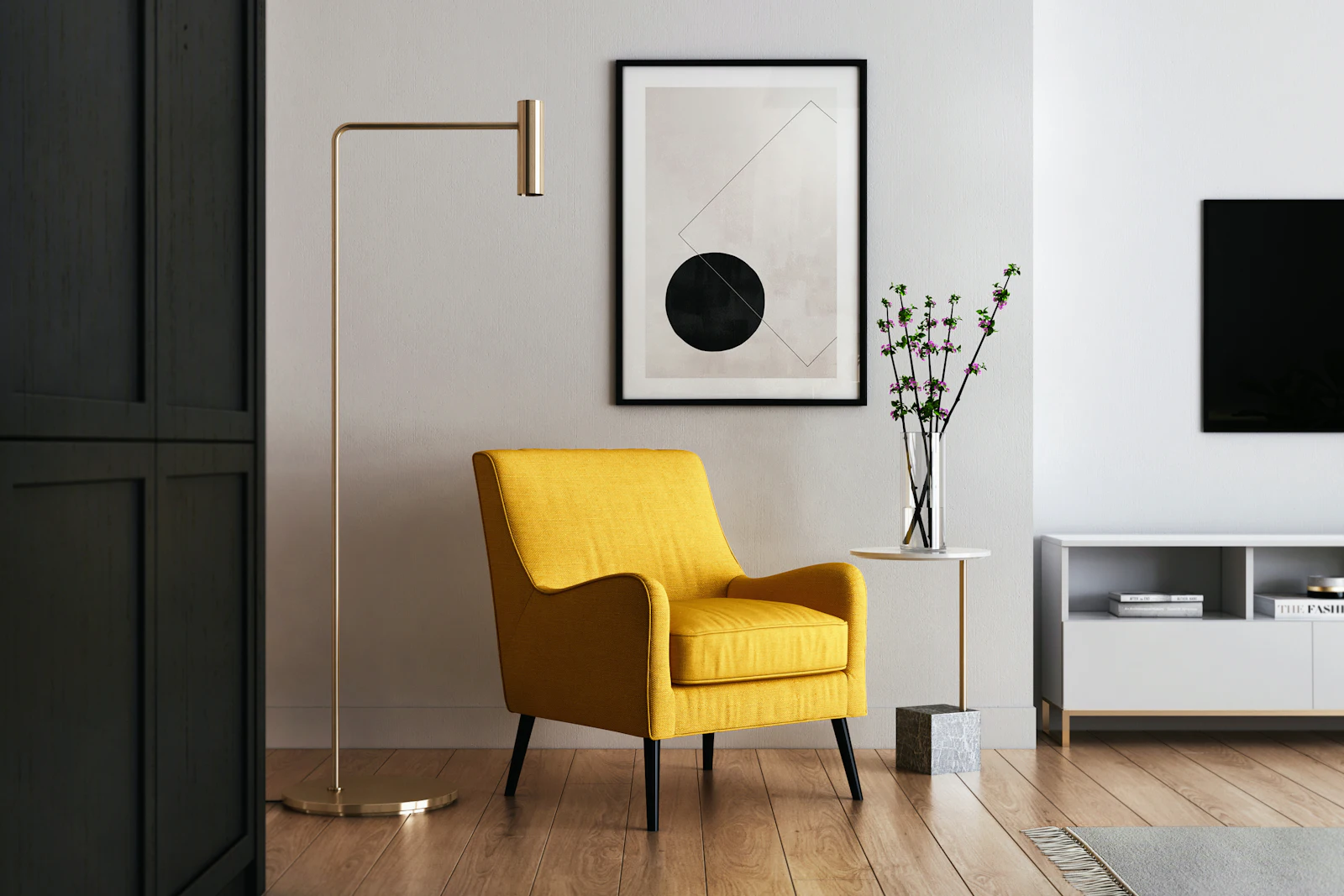
A minimalist room is not a characterless one. A single strong element, such as a sculptural armchair, a bold artwork or a vintage lamp, gives the eye somewhere to rest and makes the restraint around it feel intentional.
Choose the piece first, then let the rest of the room support it; a colourful chair holds attention best against a tonal backdrop.
Common mistake: adding a second and third statement. Two focal points compete; one leads.
7. Use mirrors, sightlines and rugs to zone
Small living rooms often serve several functions, and zoning stops them blurring together. A rug defines the seating area, a floor lamp and chair mark a reading corner, and a slim console can separate an entrance from the lounge without a wall.
Keep the longest sightline in the room clear, usually from the door towards the window, so the eye can travel its full length. A large mirror placed to reflect a window or a view through a doorway adds light and apparent depth. Size the rug generously, so at least the front legs of the sofa and chairs sit on it; a small rug floating in the middle tends to shrink a room.
Common mistake: pushing all the furniture against the walls. Pulling the sofa slightly forward and anchoring the group on a rug often makes a room feel more spacious, not less.
Proportions and clearances that keep a room usable
Good minimalism depends on proportion as much as quantity. The rules of thumb below are widely used by designers; treat them as starting points and adjust them to your room and the way your household moves through it.
| Element | General guidance | Why it helps |
|---|---|---|
| Main walkways | Keep a clear route through the room; roughly 75 to 90 cm is often cited as comfortable | Lets people pass without turning sideways |
| Sofa to coffee table | Close enough to reach a cup while leaving knee room; around 40 to 45 cm is a common starting point | Keeps the table useful without crowding legs |
| Coffee table length | Often suggested at around two-thirds the length of the sofa | Keeps the seating group visually balanced |
| Coffee table height | Level with or slightly lower than the sofa seat | Feels comfortable and keeps the room's profile low |
| Rug size | Large enough for at least the front legs of the main seating | Unifies separate pieces into one zone |
| Sofa profile | Slim arms and a lower back suit tight rooms better than deep, bulky shapes | Adds seating width without extra footprint |
A small-space checklist
- Name the room's main purposes, and limit them to two or three.
- Clear the floor of anything that could live on a wall or behind a door.
- Settle on a base palette of a few related tones before buying textiles.
- Keep at least one surface completely clear at all times.
- Provide light at three levels: ambient, task and accent.
- Check that the main sightline from the doorway is unobstructed.
- Give every object a designated home.
- Do a five-minute reset each evening.
- Reassess each season; minimalism is maintained, not achieved once.
Renter-friendly ways to apply these ideas
Not owning your walls need not rule out a minimalist small living room. Freestanding ladder shelves and slim cabinets on legs mimic the effect of wall-mounted storage. Removable adhesive hooks and strips can hold lightweight items, though you should check their weight limits and your tenancy agreement first.
Plug-in wall lights deliver layered lighting without rewiring. A large mirror leant against the wall gives the same reflected depth as a fixed one, provided it is secured against tipping; tall freestanding furniture should be anchored too, particularly in homes with children, so ask your landlord about small fixings. Where repainting is not allowed, build a tonal palette through curtains hung high and wide, a generous rug and cushions in related shades.
The bottom line
The best minimalist living room ideas for small spaces share a single logic: reduce what competes for attention, then give what remains room to breathe. Visible floor, floating storage, a calm palette and layered light all work by lengthening the way the eye travels through a room.
Start with editing, because it is free and it clarifies every decision that follows. Then make changes one at a time and live with each before the next. The same less-but-better thinking extends beyond furniture; our guide to building an eco-friendly smart home ecosystem applies it to technology, favouring fewer, better devices over clutter of a different kind.
Frequently asked questions
What colours make a small living room look bigger?
Light, soft tones with low contrast between walls, trim and ceiling tend to make a room feel larger because they blur its edges. Warm whites, pale greige and muted pastels are popular choices, but the right shade depends on your daylight, so test samples on the wall at different times of day.
Can a minimalist living room still feel cosy?
Yes. Warmth comes from texture, warm lighting and natural materials rather than quantity. Wool throws, linen curtains, timber surfaces and a couple of well-placed lamps can make a sparse room feel inviting.
Is one large sofa better than several small chairs?
Often it is. A well-proportioned sofa with slim arms and raised legs usually provides more seating per square metre and creates one calm shape instead of several competing ones. Measure carefully, including delivery routes, before ordering.
How do I keep a minimalist living room tidy?
Give every item a designated home, ideally in closed storage, and adopt a short daily reset. A simple rule for new purchases, such as letting one thing go for every new one that comes in, stops clutter creeping back.