
Image: AI-generated with Google Flow
Japandi Interior Style: Principles and How to Apply Them in a Small Home
Japandi interior style has become one of the most searched looks for small homes, and it is easy to see why: calm rooms, a few good pieces, natural materials and soft, warm colours. But the version sold through catalogues and social feeds is often just beige furniture. This guide explains the ideas Japandi actually draws on, the principles that make it work, and how to apply them in a compact Indian flat, with attention to humidity, local materials and a sensible budget.
Where Japandi comes from
Japandi is a portmanteau of "Japan" and "Scandi". The Danish Architecture Centre describes it as a style that combines Japanese and Scandinavian design traditions, with calm spaces, a small number of high-quality objects, natural materials and a warm, muted palette as its hallmarks. In the same article, Jens Sejrup, an associate professor of Japanese studies at the University of Copenhagen, sums it up as "a fusion of Scandinavian functionalism and Japanese minimalism" (Danish Architecture Centre, 2026).
The name is new, but the connection is not. The same article traces Japanese influence on Danish design from the late nineteenth century, when Japanese prints and ceramics became popular in Europe, through mid-century designers such as Finn Juhl, who designed a "Japan" furniture series in 1957. The word "Japandi" itself emerged in the mid-2010s and spread through design fairs and media from around 2016 onwards.
The Japanese side: wabi, sabi and ma
Three Japanese ideas are often cited in Japandi writing, and they are worth understanding properly rather than as slogans.
- Wabi is described in the Stanford Encyclopedia of Philosophy's entry on Japanese aesthetics as a "subdued, austere beauty". The entry stresses that it means moderation rather than harsh self-denial, and links it to the tea ceremony as developed by the tea master Sen no Rikyū in the sixteenth century.
- Sabi is glossed in the same entry as "rustic patina": the beauty of something that has aged well. The two words are often combined as "wabi-sabi" in popular writing, though the encyclopaedia discusses them separately.
- Ma is harder to translate. The architect Arata Isozaki presented it in an exhibition titled "MA: Space/Time in Japan" as an interval in both space and time, and in architecture it can refer to the space between two posts, or to a room (Christian Hubert, Ma). Japan House Los Angeles notes that while ma is often translated as "negative space", it evokes a deeper sense of a gap or pause that gives shape to the whole (Japan House Los Angeles, 2021).
The Scandinavian side: function and hygge
Scandinavian design is a twentieth-century movement known for simplicity, minimalism and functionality across furniture, textiles, ceramics, lamps and glass, which flourished in the 1950s (Wikipedia, Scandinavian design). An important strand was the idea that good design should be for everyday life. Gregor Paulsson, who directed the Swedish design society Svenska Slöjdföreningen from 1920 to 1934, published Vackrare vardagsvara ("More beautiful everyday things") in 1919, and the 1930 Stockholm Exhibition he helped drive is considered the breakthrough of functionalism in Scandinavia (Store norske leksikon).
The softer, more human side comes from hygge. VisitDenmark says the word roughly translates as "cosiness" but means more than that: "creating a warm atmosphere and enjoying the good things in life with good people", with candlelight as a classic example (VisitDenmark). The word drew international attention in 2016, when Collins English Dictionary named it runner-up for word of the year (Wikipedia, Hygge).
Put simply, the Japanese side brings restraint and space, and the Scandinavian side brings warmth and practicality. Japandi works when both are present.
The core principles of Japandi interior style
Restraint
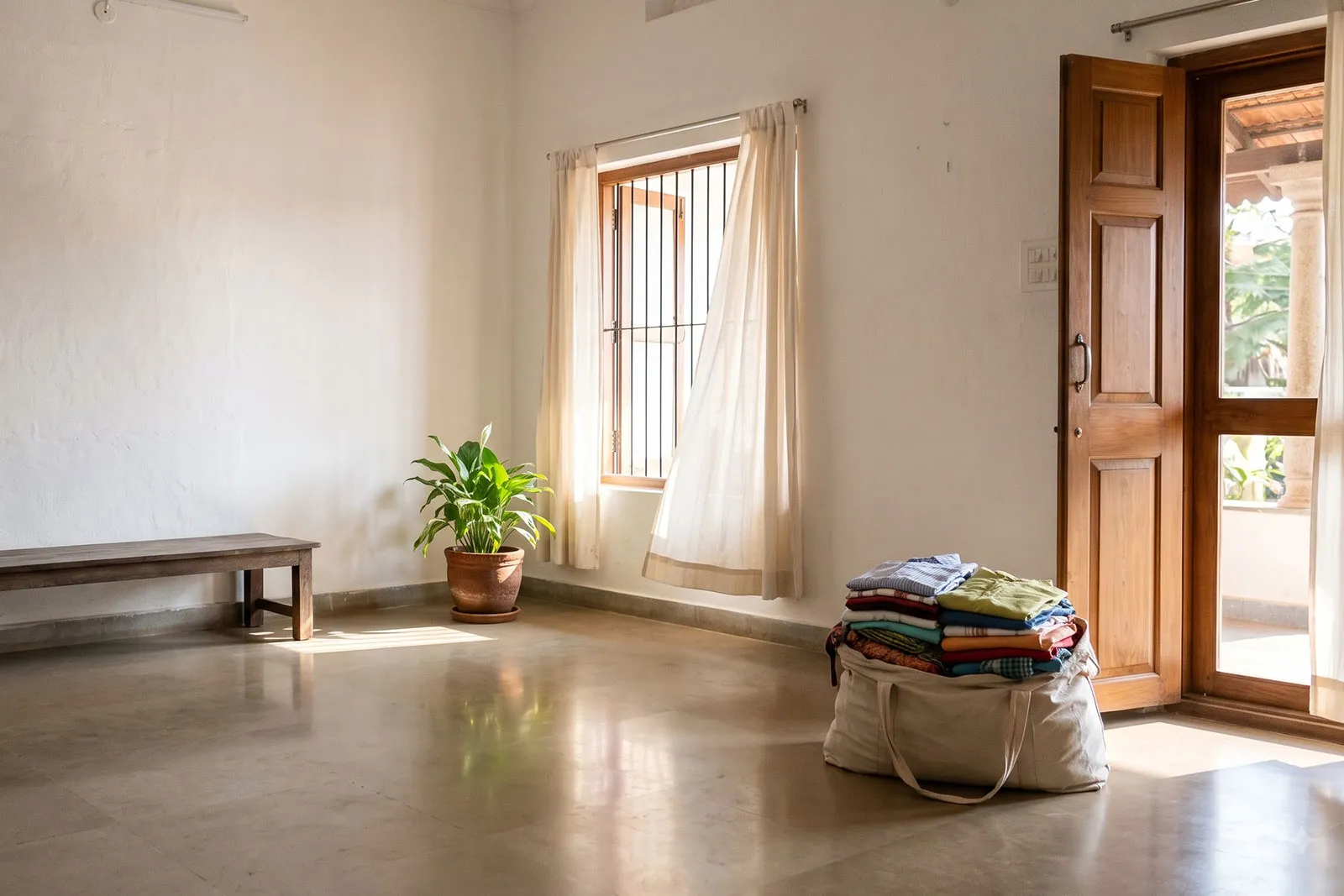
Fewer objects, each chosen for a reason. This is the same discipline described in our guide to decluttering for minimalist living, and it is the real starting point. A Japandi room built on top of clutter will not feel calm, whatever colour the walls are.
Natural materials
Wood, cane, bamboo, cotton, linen, jute, stone, clay and paper. The point is texture and honesty: materials that look like what they are and age visibly, in the spirit of sabi.
A muted, warm palette
Soft whites, warm greys, sand and clay tones, with darker accents such as charcoal, deep brown or muted green. Contrast matters as much as softness; an all-pale room tends to look flat.
Low, simple furniture
Lower seating and beds keep sightlines open and make a small room feel taller. Simple forms with visible joinery or clean legs suit the style better than heavy, carved or upholstered pieces.
Craftsmanship
One well-made stool or bowl does more than five decorative fillers. Handmade objects with small irregularities fit the wabi-sabi idea better than perfectly uniform mass-produced items.
Negative space and function
Leave walls, shelves and floor areas deliberately empty. Every piece should earn its place by being used, which is the functionalist half of the equation.
In a small flat, empty space is not wasted space. It is the part of the room that lets everything else breathe.
Palette and materials at a glance
| Element | Japandi choices | Notes for Indian homes |
|---|---|---|
| Walls | Warm white, greige, soft clay or sand | Warm whites read better than cool whites under strong daylight; test a patch at different times of day |
| Accents | Charcoal, deep brown, olive or muted indigo | Indigo-dyed cotton and dark-stained wood give contrast without bright colour |
| Wood | Light or mid-tone timber with a matt finish | Keep away from damp walls and direct rain; see the climate section below |
| Woven materials | Cane, rattan, bamboo, jute | Widely made in India; need dry, airy placement during the monsoon |
| Textiles | Cotton, linen, handloom weaves in plain or subtle textures | Breathable fabrics suit hot, humid months better than heavy synthetics |
| Ceramics and stone | Matt glazes, terracotta, unpolished stone | Local terracotta and stoneware fit the look naturally |
| Lighting | Warm-toned bulbs, paper or fabric shades, several low sources | Layered lamps give the evening warmth associated with hygge |
Applying Japandi room by room in a small Indian flat
Living room
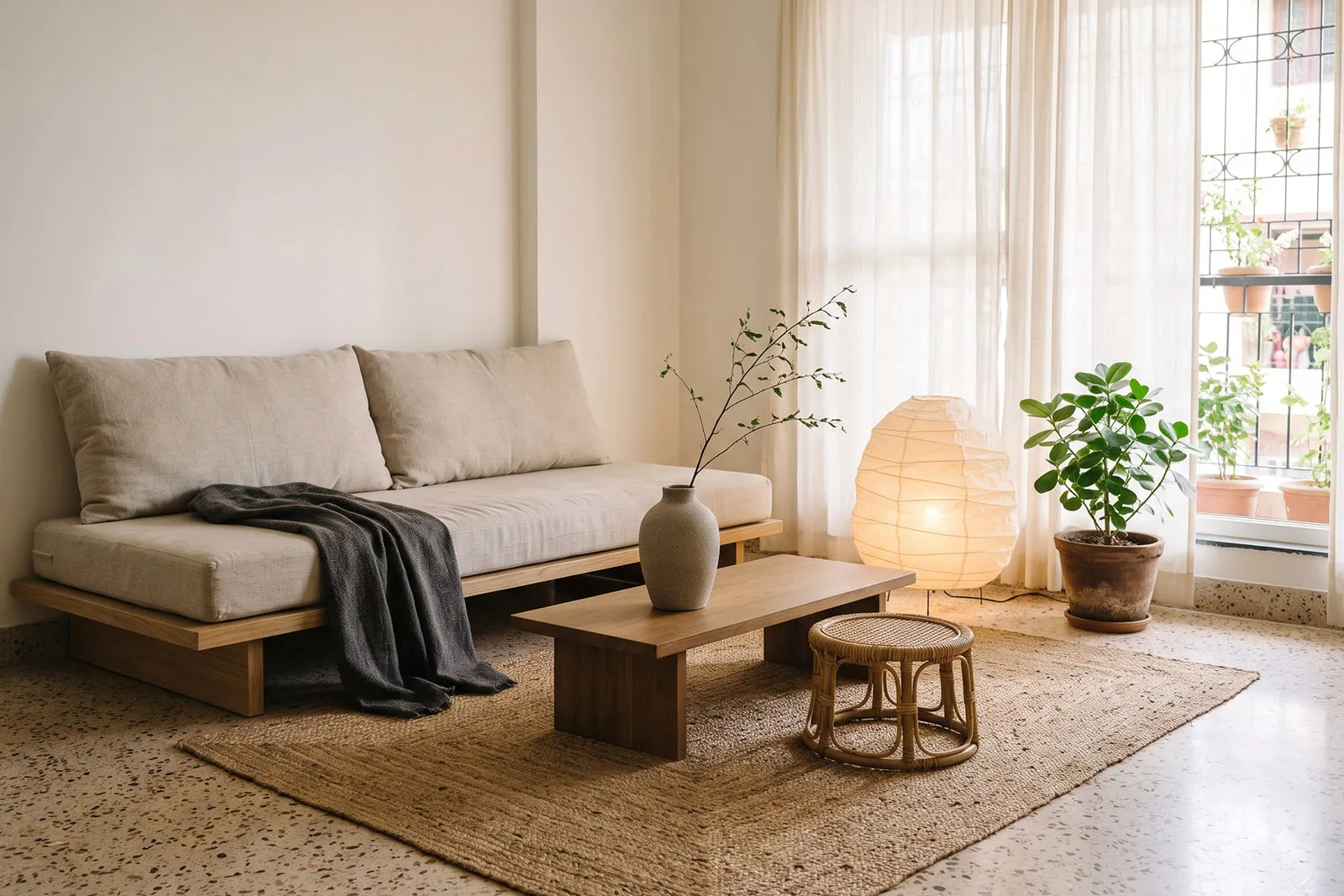
Start with the layout, not the shopping, and keep one clear walking path. A low sofa or a floor-level seating arrangement with firm cushions keeps sightlines open. Choose one low table rather than a coffee table plus side tables. Keep one or two objects on display, such as a ceramic vase with a single branch, and store everything else behind closed doors. Our article on minimalist living room ideas for small spaces covers layout in more detail.
Bedroom
The bedroom is the easiest room to make Japandi because it needs the least. A low platform bed in plain wood, cotton or linen bedding in one or two muted tones, a single bedside surface and a warm lamp are enough. Keep the wall behind the bed mostly bare. If the room doubles as a workspace, choose a desk that can be cleared fully at night so the room returns to rest.
Balcony
Many Indian flats have a small balcony that ends up as storage. Clear it and treat it as an extension of the living space: a low cane or wooden stool, a jute mat that can be brought in during heavy rain, and a few potted plants grouped together rather than scattered. Green is the one colour Japandi welcomes freely.
Storage
Japandi rooms look calm because storage is hidden. Closed cabinets with plain fronts, baskets in cane or jute for small items, and under-bed storage do most of the work. Open shelving should hold only what you are happy to look at every day.
Adapting Japandi to the Indian climate
Much Japandi imagery comes from cool, dry northern European homes. Indian flats face heat, monsoon humidity and dust, so materials need a little more care.
Wood and humidity
The US Forest Products Laboratory's Wood Handbook notes that wood is hygroscopic: "it takes on moisture from the surrounding environment", and many problems with wood come from changes in moisture content (Glass and Zelinka, Wood Handbook, 2010). Wood shrinks as it dries, and the laboratory notes that shrinkage differs by direction, with tangential shrinkage (7% to 12% from green to oven-dry) far greater than longitudinal shrinkage (USDA Forest Products Laboratory FAQ). In practice, that seasonal movement is why drawers can stick in the monsoon and joints can open in dry winter months.
Practical steps: keep wooden furniture a few centimetres away from external walls that get damp, avoid placing it where rain can reach through open windows, and do not push solid wood right up against a wall-mounted air conditioner outlet.
Mould and ventilation
Natural fibres, cane and wood can develop mould in a damp, closed room. The US Environmental Protection Agency states that "the key to mold control is moisture control", advises keeping indoor humidity below 60%, ideally between 30% and 50%, and recommends drying water-damaged items within 24 to 48 hours (US EPA). In Indian homes that means opening windows when the air outside is dry, running exhaust fans in kitchens and bathrooms, and drying any wet mats or cushions quickly rather than leaving them rolled up.
Local material alternatives
Japandi does not require imported pieces. India has long traditions in many of the materials the style relies on:
- Cane and bamboo for seating, screens, lamp shades and baskets.
- Jute and coir for floor mats and storage baskets.
- Handloom cotton for curtains, cushion covers and bedspreads in plain weaves or subtle stripes.
- Terracotta and stoneware for planters, vases and everyday tableware.
- Indigo and natural dyes for darker accent textiles that keep the palette muted.
Buying from local artisans or craft fairs also fits the craftsmanship principle better than a factory-made "Japandi" set.
Renter-friendly and budget ideas
Most of Japandi is subtraction, which costs nothing. Before buying anything:
- Clear surfaces. Empty every table top and shelf, then put back only what you use or love.
- Hide visual noise. Move brightly packaged products into cupboards or plain containers.
- Change the light. Swap cool-white bulbs for warm-white ones in living areas and add one low lamp.
- Change the textiles. Plain cotton or linen cushion covers and a plain bedspread shift the palette without painting.
- Avoid drilling. Lean a single framed print or mirror against the wall instead of hanging several.
- Buy second-hand. Solid wood and cane pieces from resale platforms can be cleaned, sanded and oiled.
Common mistakes to avoid
Making it too sterile
Japandi is not empty minimalism. Without the hygge half, the warmth of textiles, soft light and a few personal objects, rooms can feel cold. Keep one or two things that carry meaning, such as a family brass lamp or a handmade bowl.
Making it too beige
When every surface is the same pale tone, the room loses depth. Add contrast through a dark wood piece, a charcoal cushion, black metal hardware or a deep green plant.
Buying a "look"
Replacing furniture to match a trend works against the principles of restraint and longevity. Frederik Werner of Norm Architects, quoted by the Danish Architecture Centre, warns that the label risks making these ideas "seem superficial" (Danish Architecture Centre, 2026). Start with what you already own and change only what clearly does not fit.
Japandi and sustainability
The principles of restraint and craftsmanship point naturally towards buying less and keeping things longer. Furniture is a large waste stream: in the United States, for example, the EPA reports that furniture and furnishings generated 12.1 million tons of municipal solid waste in 2018, and 80.1% of it was landfilled (US EPA, Durable Goods). Comparable national figures for India are not readily available, but the lesson applies anywhere: durable pieces that can be repaired, re-oiled or re-upholstered are better than cheap items that are replaced every few years.
Choose solid construction over veneered particle board where you can, natural fibres that can eventually biodegrade, and finishes that can be renewed. Treat patina and small repairs as part of a piece's character, which is close to the original idea of sabi. If you are planning a larger refresh, our guide to an eco-friendly smart home design covers energy and materials more broadly.
The bottom line
Japandi interior style combines Japanese restraint and respect for space with Scandinavian warmth and practicality. In a small Indian flat, that translates into fewer, better objects, hidden storage, natural materials suited to the climate, warm layered light and deliberate empty space. Start by removing rather than buying, use local cane, jute, cotton and terracotta, manage humidity to protect wood and fibres, and add a little contrast so the room feels calm rather than bland. Done well, it is less a trend than a way of living with less.
Frequently asked questions
What is the difference between Japandi and Scandinavian style?
Scandinavian style tends towards lighter woods, brighter whites and cosy layering. Japandi adds Japanese influences: more restraint, lower furniture, darker accents and a stronger emphasis on empty space and imperfect, handmade objects.
Can Japandi work in a rented 1BHK?
Yes. Most of the effect comes from decluttering, warm lighting, plain natural-fibre textiles and rearranging furniture, none of which requires changes to the property.
Is wooden furniture a good idea in humid Indian cities?
It can be, with care. Wood absorbs and releases moisture from the air, so keep it away from damp walls and rain, ventilate rooms well and expect some seasonal movement in drawers and doors.
Do I need to buy new furniture to get the Japandi look?
No. Start with what you own, remove what does not fit, and replace only pieces that are clearly out of place. Second-hand solid wood and cane can often be refinished to suit the style.
Sources
- Japan and Scandinavia found each other long before we learned to call it Japandi, Danish Architecture Centre, 2026.
- Japanese Aesthetics, Stanford Encyclopedia of Philosophy (Parkes and Loughnane), 2023.
- Ma, Christian Hubert, 2019.
- MA in Contemporary Japanese Architecture, Japan House Los Angeles, 2021.
- Scandinavian design, Wikipedia, accessed 2026.
- Gregor Paulsson, Store norske leksikon, accessed 2026.
- What is hygge?, VisitDenmark, accessed 2026.
- Hygge, Wikipedia, accessed 2026.
- Moisture relations and physical properties of wood (Wood Handbook, Chapter 4), Glass and Zelinka, USDA Forest Service Forest Products Laboratory, 2010.
- Frequently asked questions, USDA Forest Service Forest Products Laboratory, accessed 2026.
- A Brief Guide to Mold, Moisture and Your Home, US Environmental Protection Agency, accessed 2026.
- Durable Goods: Product-Specific Data, US Environmental Protection Agency, accessed 2026.