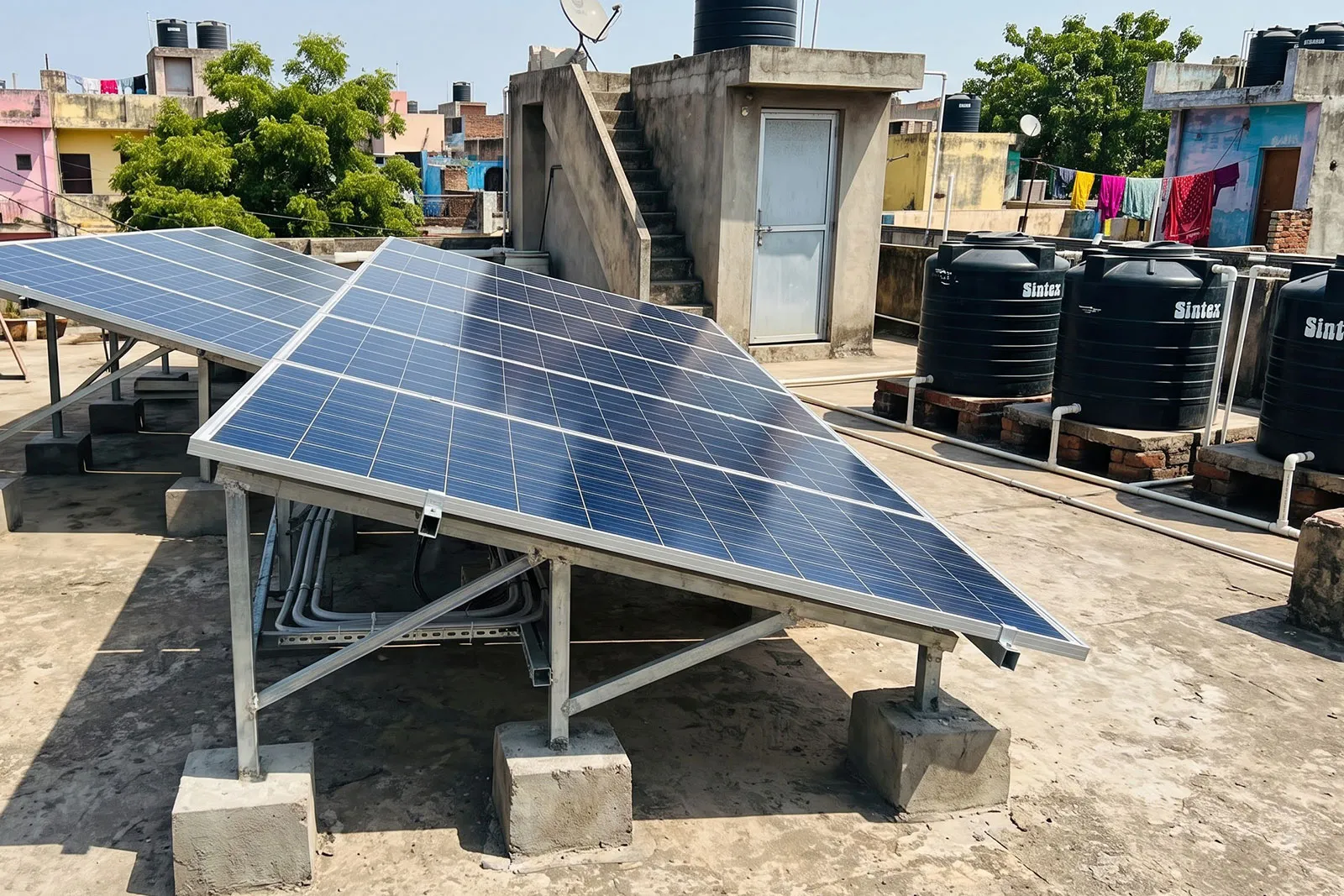

Image: AI-generated with Google Flow
Rooftop Solar Subsidy Calculator: PM Surya Ghar Savings and Payback
This solar rooftop subsidy calculator works out what the PM Surya Ghar: Muft Bijli Yojana would pay towards a grid-connected system on your home, what you would pay after the subsidy, and roughly how long the panels would take to pay for themselves. The subsidy rates come from MNRE's guidelines. The rest of the sum comes from your own quote and electricity bill.
Your estimate
- Central subsidy
- ₹78,000
- You pay after subsidy
- ₹67,000
- Simple payback
- About 3.1 years
- Saving in year one
- ₹21,681
- Generation
- 301 units a month
- Net saving after 10 years
- ₹1,44,996
- Shade-free roof needed
- 30–36 m² (323–388 sq ft)
Subsidy ₹78,000, you pay ₹67,000, payback about 3.1 years.
An estimate, not a quote. The result is only as reliable as the price and tariff you enter. Confirm the subsidy and any state top-up on the National Portal for Rooftop Solar before you sign anything. For eligibility rules and the application steps, read our full guide to the rooftop solar subsidy in India.
How the calculator works
The subsidy
The central subsidy, called Central Financial Assistance (CFA), is set in the MNRE operational guidelines. It is ₹30,000 per kW for the first 2 kW and ₹18,000 for the third kW, capped at ₹78,000. In special category states and UTs the rates are ₹33,000 and ₹19,800, capped at ₹85,800. Capacity above 3 kW earns nothing extra. The calculator applies these per-kW rates to the size you enter:
| System size | Central subsidy (most states) | Special category states and UTs |
|---|---|---|
| 1 kW | ₹30,000 | ₹33,000 |
| 2 kW | ₹60,000 | ₹66,000 |
| 3 kW or more | ₹78,000 | ₹85,800 |
The price
The price box starts at MNRE's benchmark cost: ₹50,000 per kW for the first 2 kW and ₹45,000 for each further kW. The guidelines use the benchmark to set the subsidy, not to cap what vendors charge. Real quotes vary with roof type, structure height, inverter brand and wiring, so replace it with your own quote. Above 3 kW the calculator keeps adding ₹45,000 per kW; that part is our assumption, not an official figure.
Generation
The default of 3.3 units per kW per day comes from the PIB figure that a 3 kW system can generate over 300 units a month on average. MNRE's rooftop solar FAQ gives 4 to 5.5 units per kW on a clear sunny day. The yearly average is lower because not every day is clear. The same FAQ says each kW needs about 10–12 square metres of shade-free roof, which is where the roof-area figure comes from.
Savings and payback
Each unit you generate and use yourself is valued at your tariff. If you enter your monthly use, generation beyond it is treated as surplus and valued at the export rate you enter. Otherwise every unit is assumed to replace a unit you would have bought. Simple payback is your cost after subsidy divided by the first-year saving. The 10-year figure reduces output by 0.5% a year, the maximum degradation the scheme's technical specification allows, and then subtracts your cost after subsidy.
Suggested size
When you enter monthly use, the calculator shows PIB's sizing bands: 1–2 kW for up to 150 units a month, 2–3 kW for 150–300 units, and above 3 kW beyond that. Summer air-conditioning can double use in April and May, so base it on a full year of bills.
What the estimate leaves out
- Loan interest. If you borrow, add the interest to your cost. PIB mentions collateral-free loans at about 7% for systems up to 3 kW, and the rate moves with RBI policy.
- Tariff changes. The calculator holds your tariff flat for ten years. Tariff increases would shorten the payback, and cuts would lengthen it.
- Slab tariffs. If solar removes your most expensive top-slab units, your real saving per unit can be higher than your average rate.
- Repairs after the contract. The vendor's comprehensive maintenance contract covers five years. Budget for repairs, and possibly an inverter replacement, after that.
- Net billing. Where surplus is not carried forward, the DISCOM buys it at its own rate, usually below the retail tariff. Enter that rate in the surplus box.
Before you rely on the number
The subsidy is paid only for grid-connected systems with Indian-made modules from Indian cells, fitted by a vendor registered on the national portal, and it is released after the DISCOM inspects the system and fits the net meter. Check that your quote includes the net meter, structure, earthing and GST, and get at least two quotes. Our PM Surya Ghar guide lists the questions to ask a vendor before you sign.
Frequently asked questions
Does a bigger system get a bigger subsidy?
Only up to 3 kW. A 6 kW system receives the same central subsidy as a 3 kW one: ₹78,000, or ₹85,800 in special category states and UTs.
Which tariff should I enter?
Use the effective energy rate from your own bill: the energy charges divided by the units billed. Leave out fixed charges and meter rent, because you pay those with or without solar.
Is the calculated subsidy what I will receive?
It is the central amount the guidelines set for the panel capacity you enter. The amount actually released depends on the capacity the DISCOM inspects and approves, and on your application meeting the scheme's conditions.
Can I use this calculator for a flat?
The individual subsidy needs a roof you can install on. Housing societies and RWAs have a separate route at ₹18,000 per kW for common facilities, which this calculator does not cover.
Sources
- Amendment in Guidelines for Implementation of PM-Surya Ghar: Muft Bijli Yojana for the component of “CFA to residential consumers” (with Operational Guidelines dated 07.06.2024), Ministry of New and Renewable Energy, 2025.
- PM Surya Ghar: Muft Bijli Yojana Turns One – Powering India’s Solar Revolution, Press Information Bureau Research Unit, 2025.
- Frequently Asked Questions: Solar Rooftop System, Press Information Bureau Research Unit (Ministry of New and Renewable Energy), 2022.
- National Portal for Rooftop Solar, Ministry of New and Renewable Energy, 2026.